.png)




10-Minute Presentation
Plant-Insect Ecosystems
.jpeg.jpg "Sophia M. Gulutzo (she/her/hers) photo")
Sophia M. Gulutzo (she/her/hers)
MS Student
Colorado State University
Fort Collins, Colorado
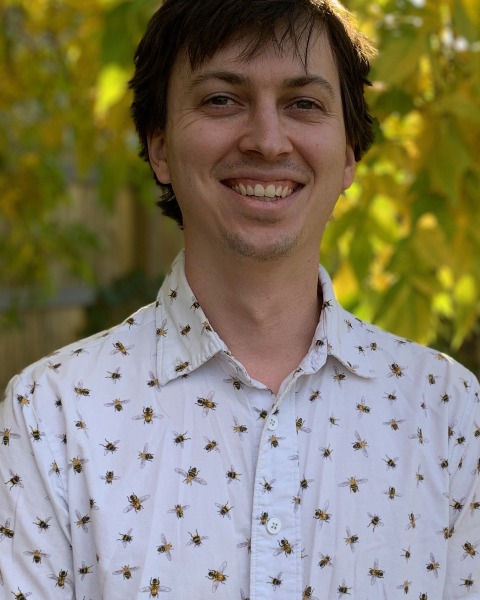
John Mola
Colorado State University
Fort Collins, Colorado
Radio telemetry has long been a cornerstone method for tracking the movement and behavior of large vertebrates, yet its adaptation to insects has been limited by transmitter miniaturization and battery constraints. Early experiments with bumble bees (Bombus spp.) have demonstrated proof of concept but are hindered by heavy equipment and short signal ranges.
This talk reviews the historical development of radio telemetry in entomology, synthesizes its current applications for studying bumble bee foraging, homing, and nesting, and presents new empirical work testing feasibility across tag loads and body sizes. Using controlled flight assays and mock-tag trials, I quantify flight thresholds, behavioral responses, and the physiological limits that determine which individuals can successfully carry transmitters. These findings clarify why successful deployments remain rare and suggest practical guidelines for tag selection, attachment, and study design.
I conclude by highlighting future directions, including hybrid tracking systems using RFID, harmonic radar, and emerging GPS microtags. Collectively, these innovations promise to overcome existing technological barriers and enable the fine-scale tracking of bee movements across natural landscapes. Expanding the spatial and temporal resolution of bee telemetry will deepen our understanding of pollinator movement ecology, nest detection, and landscape connectivity—advancing both basic and applied conservation goals in an era of rapid environmental change.